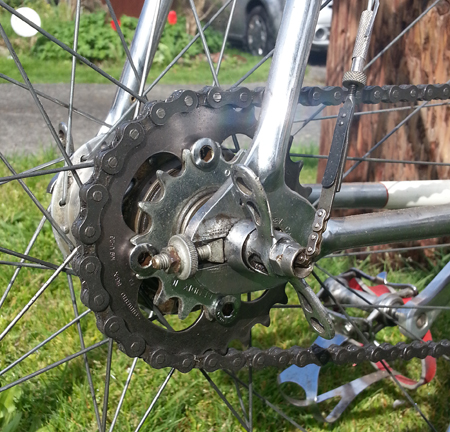
Sturmey Archer Hub Gears
AW THREEE SPEED
Since my first three-speed, I have been fascinated with gearing and could not resist fiddling around with them. It started in sixth grade while changing cogs on my three speed to find the right fit. I saw two cogs on my pile sitting back to back and it hit me. Since the cogs were dished I could mount both cogs on the driver back to back and get six speeds, giving me closer ratios.
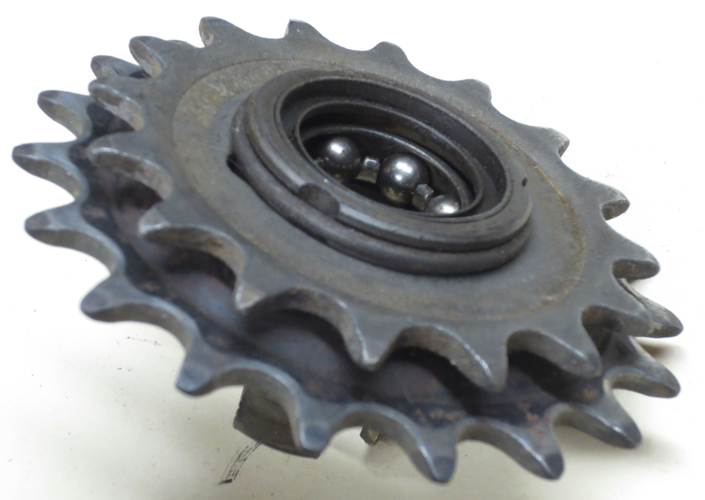
A quick check on my slide rule (an antique analog calculating device) showed me that a 19-22 cog combination would exactly split the 4/3 ratios of the three speed for touring, and a 14-16 pretty close for hotdogging. A while later I had a simple two speed derailleur made from a tandem idler pulley, door spring, Sturmey shift lever, and other oddments. By seventh grade I had discovered british cycling magazines and catalogs, and off-the-shelf derailleurs. Soon I had a commercial freewheel mounted on top of my three speed. A freewheel had the same thread as the old threaded sturmey drivers
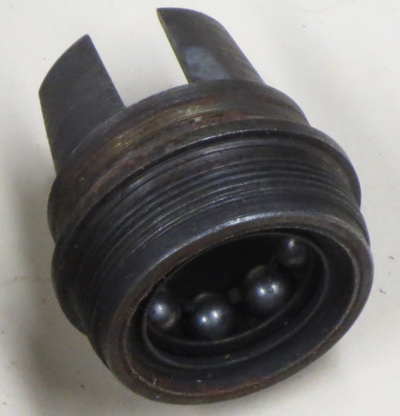
so all I had to do is lock up the freewheel with epoxy and screw it on to have a Kajillion speed bike. They were fun for awhile.
FW FOUR SPEED
The next revelation came in high school. I had been scrounging through buckets of hub gears cut out of wheels in myriad shops, looking for long axles, aluminum shells, threaded drivers, or anything else interesting, when I discovered an FW four speed. After asking the shopkeeper what FW was I thought: Wow! This could be the best thing since sliced bread, however....
WONKY FOUR SPEED FROM FW (different ratios)
After riding the FW awhile, I was underwhelmed by the choice of gear ratios. The illustration below comparing the gear ratios of the AW three speed, FW four speed, and variations I created from the FW will make the discussion clearer:
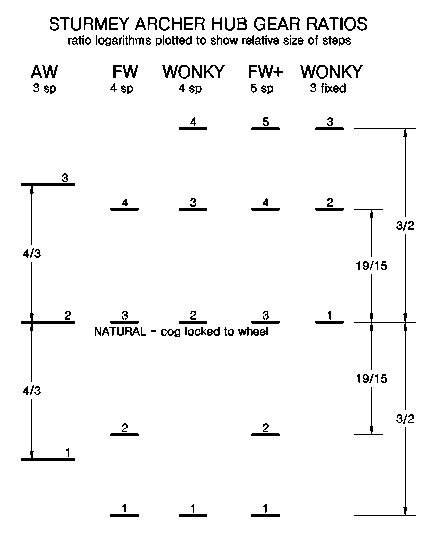
The FW natural, the gear where the cog is locked to the wheel like a single speed freewheel, was the third gear. The left planetary set was used for the second and fourth gears, 15/19 down from natural and 19/15 up from natural. The steps between those gears were about 5% smaller than the AW three speed, some improvement but not as good as hoped. The right planetary set was used only for the bottom gear with a ratio of 2/3 down from natural, giving an overall range from fourth to first of 19/10, about 7% more than the AW, again not a stunning improvement. Worse yet, the jump from first to second was only 38/45, about 7% less than the 2-3 and 3-4 steps. That was just the opposite of what I wanted. I would have preferred closer ratios up top where I spent most of my time, with a big jump down to a bailout low gear.
Of the five gears the double planetary gears were capable of, Sturmey had chosen to use the bottom four, omitting the top one. It ocurred to me that if I could figure out a way to rearrange the clutches and indicators to leave out the second of the five instead, I would have a choice of gears that would serve my needs better. The overall range would be 9/4, about 26.5% wider than the AW and 18% wider than the standard FW. Better yet, each successive gear step from bottom to top would be smaller: second 50% higher than first, third 27% higher than second, and fourth 18% higher than third.
I had to have it, and could if I were willing to accept a wonky shift sequence. The close ratio planet gear is engaged in the far left slack gear cable position, my new third gear, so I was stuck with the shift pattern being reversed between the top two gears. My first lever click would move the planet gears right, actuating the right (wide ratio) planet for fourth gear. The next two clicks would get the second (natural) and first gears in the usual way by moving the right hand sliding clutch. My shift lever sequence would be 1-2-4-3 instead of 1-2-3-4. No big deal. I always know what gear I am in and Sturmey shifts are instantaneous, so it was a small sacrifice.
To accomplish this mechanically, I used the indicator setup below;
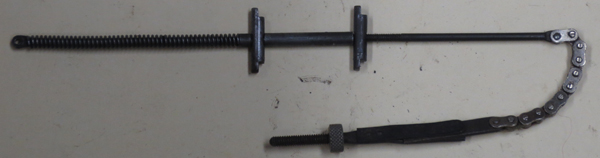
The two narrow rods of the indicator both screw into the fatter threaded rod in the middle. The two pins both have unthreaded holes in their center so they can slide on the narrow rods. The fatter rod is the length that just touches both pins when in the high gear position (where the left pin is as far as it can go to the right and the right pin is as far as it can go to the left). The long spring on the left is just strong enough to overwhelm the planet return spring.
Here's what happens while shifting: When the shift cable is slack in second gear both pins are as far to the left as they can go, held there by their return springs. As the cable tightens going to second gear, the left pin moves to the right, pushed by the tight spring on the left indicator rod, moving the planets to disengage the left sun gear and engage the right one. Nothing happens on the right side while this is going on because the narrow right rod of the indicator is sliding freely through the hole in the right pin, which stays where it is.
For the next shift down from third to second (natural) the right end of the fat rod pushes the right pin to the right, off of the gear cage dogs and onto the ring cage dogs. Nothing happens with the planets, as the narrow left rod of the indicator is sliding through the hole in the left pin while the long compensator spring is compressing. On the shift from second to first, the right pin continues to the right, disengaging the ring gear pawls for first gear. The planets are still in the wide ratio position so one gets the lowest gear possible.
Of course, the indicator cable spacings for these gears do not match the FW, so the gear lever shoulders had to be ground down for the new spacing. Also, in order that the low gear cable tension would not be impossibly high when the compensator spring was compressed, it had to be very long, protruding from the left end of the axle. I covered it by using another long right hand sturmey nut on the left side.
I used this setup happily on my training/commuting/utility clunker bike for a few years until the bike was stolen.
FIVE SPEED FROM FW FOUR SPEED
When the wonky four-speed was stolen I had a stock of FWs laid in, so the only question was how to set one up for the next clunker. I liked the idea of only one shift lever, but it was far easier to create a five speed from stock parts so I rationalized that I would probably use the extra gear sometime and went for a five speed with two levers. I could use the indicator chain and shift lever from the AW three speed on the right side to choose between high, natural, and low, and use a separate lever and indicator on the left to choose between the close and wide ratio for the highs and lows. Shimano's three speed used a bellcrank and rod that could work on the left, but the threads to the axle did not match. It worked after sawing out the bellcrank slot all the way through the mounting threads.
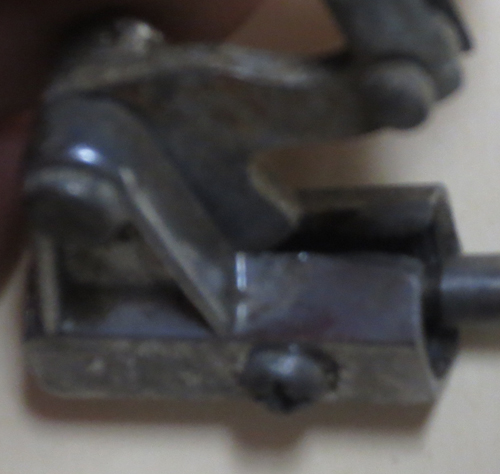
A little extra force while torquing it on to the nicely hardened Sturmey axle widened the soft pot metal of the bellcrank housing to a nice press fit with no need for a lock nut. One more AW shift lever for the left side and I was done.
That was OK for a couple of weeks, but it was kinda a kludge and irritated me that the levers in the high gear range moved in opposite directions. I kept wanting the super high to be with both levers all the way up. The answer to that was replacing the bell crank on the left with modified Sturmey parts, adding a compensator spring to an old skinny indicator rod, with a washer at the left end that would fit into and rest against the axle nut to hold the spring.
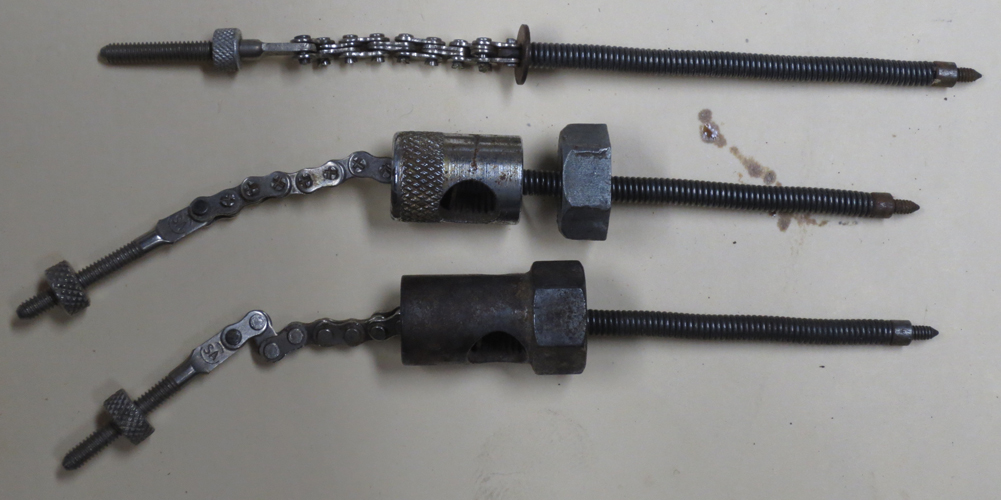
The compensator spring was stronger than the planet return spring (as in the wonky four speed), so the loose cable position was with the right (wide ratio) planets engaged instead of the close ratio ones. This worked well mechanically, the highest gear was with both levers up, and the arrangement looked nice and symmetrical. I was so pleased with the result and it was such an easy conversion that I made a bunch of the compensator spring indicators for any friends that might want to do the same thing
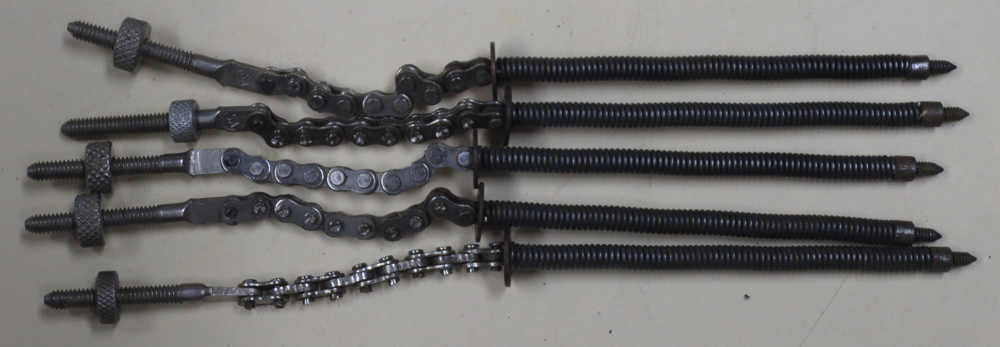
but was disappointed that not one cared. Ten speeds were the thing and nobody shared my love for utility clunkers. Nobody seemed to appreciate the trouble free dependability, easy maintenance, and fast shifting while dragging away from stop lights. They said "how can you ride that heavy thing?" and my reply was "Have you weighed your cogs, derailleur, extra chainring, longer chain, and shift levers all together?" Oh, well, to each his own.
THREE SPEED FIXED FROM FW FOUR SPEED
My last adventure with hub gears, that I just returned to service, was a three speed fixed. In my early college racing years I had been riding a fixed gear around Chicago a lot in training. When I found out from Harold Ade, my old mentor, that Sturmey had once made a three speed fixed model ASC I had to have one. I placed ads in British cycling magazines and got two of them. Eager to examine such a rarity (even in the sixties) I took one apart as soon as it arrived. To my dismay, the ratios were very narrow (4/3 overall) and the components appeared fragile to me. I was at my peak strength at 220 pounds, had already bent a set of cranks, and did not want to take a chance of ruining the ASCs. One of them went into a wooden rim for history and the other into my three speed unicycle. Here's the mad cyclist with the first frame experiment on that, a cutoff mixte frame. The cranks could not be mounted directly to the hub, so a tall unicycle and chain were needed.
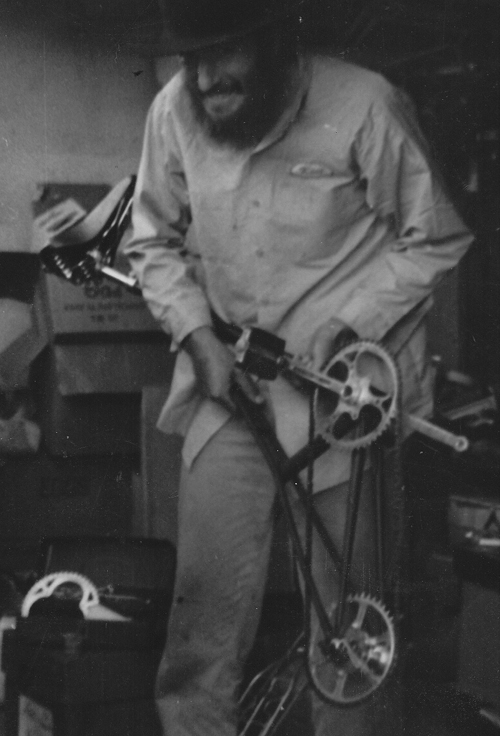
I thought the ASC would be OK for the unicycle because on a unicycle torque is not an issue, but it really wasn't even good there because the unicycle really needed overall ratios of at least 2 to 1 to be worth putting up with the slop in the gears, which is really annoying on a unicycle where every pedal stroke involves some back pedaling.
Not willing to give up, I took another look at one of my trusty spare FWs. The gears were robust and the gears and clutches pretty tight - the basic requirements for conversion.
My main worry was the impact that shifting a fixed gear puts on all the components. Unlike its freewheeling cousins, where the rider can just take all the load off the gears for the shift by slowing his pedaling, fixed gear changes are always something of a crash. Unlike in a car, there's no friction clutch to disengage the gears or synchromesh to match the teeth up before reengaging. If you're cruising along at 90 cadence in high gear and shift to the closer ratio below, the gear must accelerate the cranks to 107 rpm pretty much instantaneously, kinda like hitting everything inside with a hammer. The faster you're spinning, the bigger the gear step and the heavier your feet, the worse it is. Building in a neutral would be a mixed blessing. If I had a neutral that I could move to between gears, when coming out of a gear I could guess what the proper cadence would be for the next gear and try to approximate it before dropping into the next gear. If I were skilled and practiced enough, I could eliminate the impact altogether. The old time truckers had to be good at this. The really bad side of neutral is that if I made a mistake it could be disastrous. Imagine coasting down a hill in neutral at high speed, quiet as the wind with no freewheel buzzing, and mistakenly hitting the gear lever. The impact would be tremendous and the gear would be toast, not to speak of what might happen to the rider.
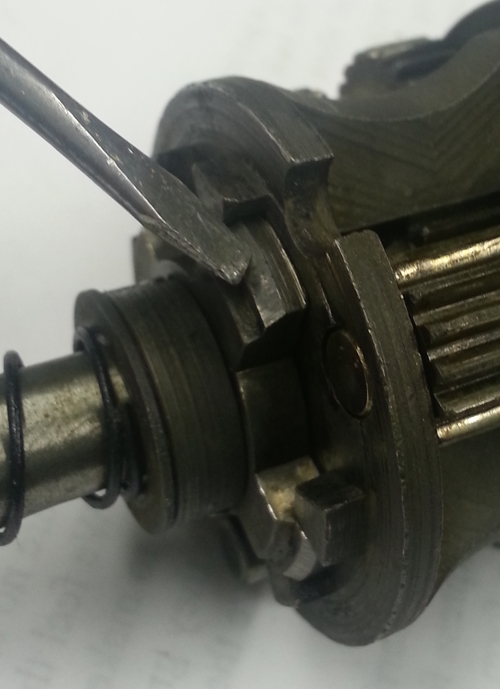
Scottish gloomy worrying aside, I had to go for it. I took out the ratchet pawls, ground a chamfer on the ends of the ring gear clutch dogs to make space for a formal neutral
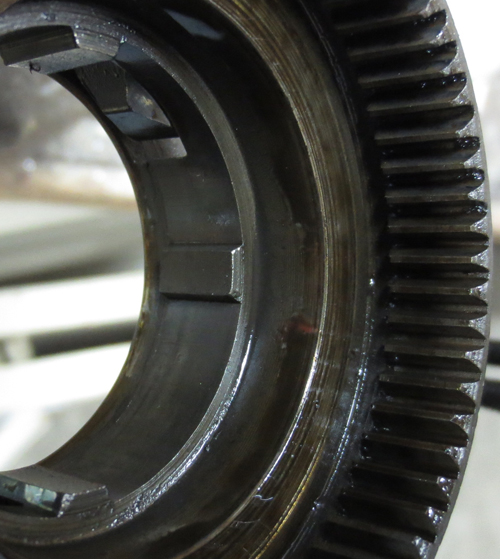
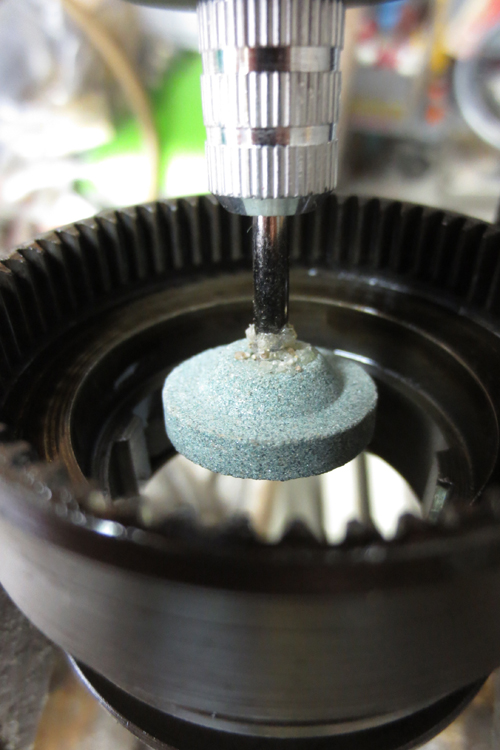
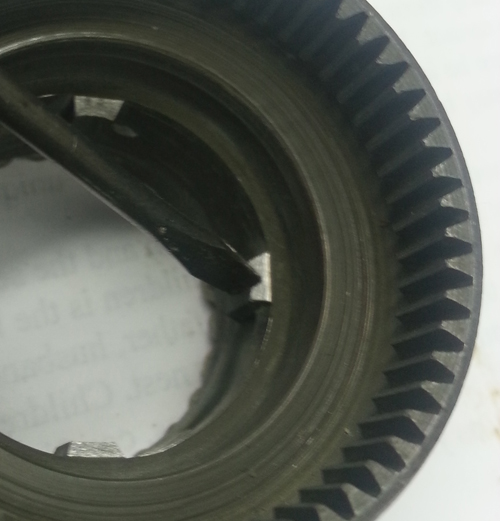
ground a chamfer on the sliding clutch to match
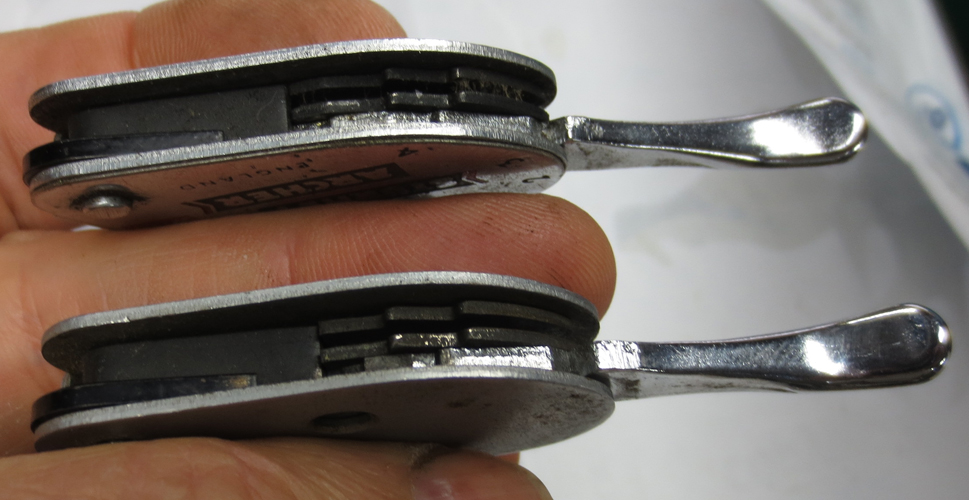
epoxied the ring gear/clutch to the right hand ball cup, made an indicator and shift lever similar to the wonky four speed - a picture of the standard (top) and modified (bottom) levers;
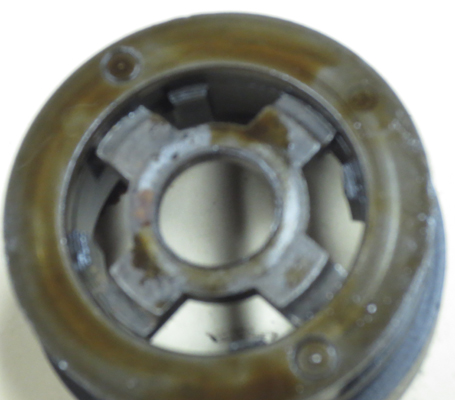
put a touch of epoxy on the right hand ball cup when assembling to the shell (didn't want it to unscrew when backpedaling, and it was lucky I had a left hand ball cup with wrench flats on it or I never would have been able to get the guts out for service later) and it was done.
In general I was pretty happy with it. The downsides were two. First, the gear shift sequence was mixed up like the wonky four speed. Pulling the lever down from loose to tight cable it went 2-3-neutral-1(natural). The wonky four speed had innoculated me to that so it wasn't too bad. Second, the first gear (natural) clutches are really sloppy, allowing a lot of movement before the backpedaling engages, so it really is not fully "fixed".
That isn't really bad either, as I only use the bottom gear for honking up hills, where back pedaling never happens. The big upside for me is that the bottom gear is the natural, so when I am honking up the aforementioned hills with the trailer on there is no stress on the internal gears and I don't have to worry about crunching them. I was even confident enough in it that I rode it in the Tour of the Scioto River Valley with my club friends.
One last mod: Last week (half a century later) when I brought back the 3-fixed from retirement to put back on my track bike for fun, I realized that the 90 inch top gear that had been my old favorite was too high for me. I'm 72 now and my crank bending days are long gone. I was not about to find a smaller chainring for my old Campagnolo Record cranks, and the 22 tooth cog I had been using was the largest I had, so I had a problem. While browsing through the used chainrings at Recycled Cycles for mods to my Avatar, I saw some four bolt inner chainrings. It occurred to me that the hole pattern was suspiciously close to the tooth gaps on a 16 tooth cog. I asked John for a 16 cog to look at for comparison and it looked like it could be a go for bolting together. He was into mechanical adventuring and gave me the ring and some used chainring bolts to try it out. A little minor grinding and my 26 tooth cog was bolted together.
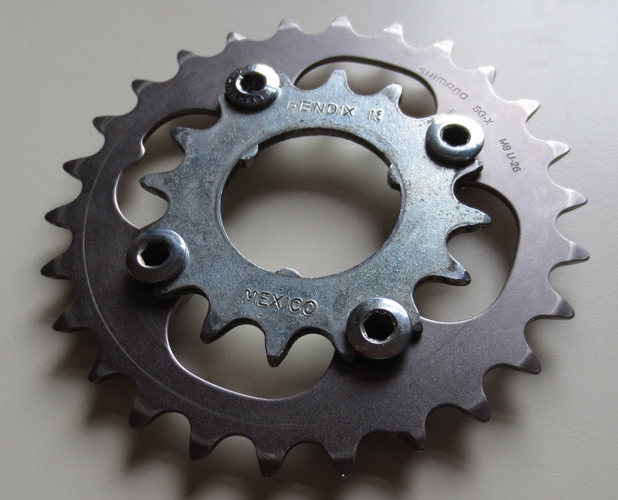
The wonky three speed fixed was back....in grandpa mode!